To prepare documentation for AI, make sure every page is current, consistent, self-contained, clearly titled, correctly permissioned and owned by someone. AI assistants retrieve and summarize what you have written, so the work is mostly about the content, not the tooling.
This checklist is organized into seven areas. Work through each one, then use the scored self-assessment at the end to see where your AI-ready documentation stands and where to start.
Why documentation for LLMs needs different preparation
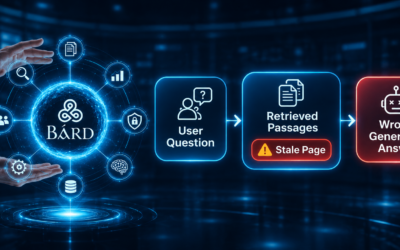
People read documentation in context. They arrive from a navigation menu, scan the page, notice the date and skip the parts that do not apply to them. A large language model working through a retrieval system does none of that. It receives passages, often stripped of the page around them, and treats them as true.
That changes what “good enough” means. A page that a human can work around may produce a confident wrong answer from an assistant. Preparing documentation for LLMs means removing the ambiguities that people quietly resolve for themselves.
How to prepare documentation for AI: the checklist by area
1. Currency
- ☐ Every published page reflects the current product or process.
- ☐ Superseded versions are retired, unpublished or excluded from the AI index.
- ☐ Pages carry a last-reviewed date that is actually maintained.
- ☐ There is a routine for updating content when a release changes behavior.
Outdated content is a frequent cause of wrong AI answers. If you do nothing else, remove what is no longer true.
2. Contradictions
- ☐ Each topic has one authoritative page.
- ☐ Other pages link to that page rather than restating it.
- ☐ Known conflicts between help center, internal and sales content have been resolved.
- ☐ Terminology is consistent, so one concept does not have three names.
An assistant cannot tell which of two conflicting pages is right. It will pick one, or merge them.
3. Structure and chunking
- ☐ Each section covers one topic or task.
- ☐ Sections make sense on their own, without “see above” or “as mentioned earlier”.
- ☐ Long pages that cover many topics have been split.
- ☐ Procedures use numbered steps, and reference data uses tables.
Retrieval systems split content into chunks. Structure that keeps each chunk complete gives the assistant a better chance of answering correctly.
4. Titles and metadata
- ☐ Page titles and headings describe the content specifically.
- ☐ Product, version, audience and region are stated on the page, not only implied by navigation.
- ☐ Metadata fields such as product, content type and owner are filled in consistently.
- ☐ Titles reflect how users phrase their questions where possible.
Titles and headings are an important signal for many retrieval systems. “Overview” tells it nothing.
5. Access and permissions
- ☐ You know which content the assistant can reach.
- ☐ Internal-only content is not exposed through a customer-facing assistant.
- ☐ Sensitive material is permissioned correctly at the source.
- ☐ Draft and archived spaces are excluded from indexing.
Some assistants respect the permissions of the system they connect to, which means overly broad permissions become overly broad answers. Check how your specific platform behaves, and confirm access decisions with your security team.
6. Gaps and tacit knowledge
- ☐ You have a list of frequently asked questions that have no documented answer.
- ☐ Workarounds and known issues held by support or engineering are written down.
- ☐ Specialists have a simple way to contribute what they know.
- ☐ New gaps found through assistant logs feed back into the writing queue.
If an answer is not documented, the assistant will retrieve the closest thing instead.
7. Ownership
- ☐ Every page or content area has a named owner.
- ☐ Owners have scheduled review dates.
- ☐ Someone is accountable for the AI assistant’s answer quality as a whole.
- ☐ Wrong answers are logged and traced to source content.
Without ownership, the content you fix this quarter drifts again by the next release.
Scored self-assessment
Score each area from 0 to 3 using the descriptions below. Be honest; the point is to find where to start, not to pass.
| Area | 0: Not in place | 1: Partial | 2: Mostly | 3: Fully |
| Currency | Old versions live, no review dates | Some cleanup done | Most old content retired | Release-linked updates, maintained dates |
| Contradictions | Same topics in many places | Major conflicts known | Single sources for key topics | One source of truth throughout |
| Structure and chunking | Long mixed-topic pages | Some pages split | Most sections self-contained | Consistent one-topic sections |
| Titles and metadata | Generic titles, no metadata | Some descriptive titles | Context stated on most pages | Consistent titles and metadata |
| Access and permissions | Unknown what is exposed | Known but untidy | Reviewed, minor issues | Reviewed and controlled |
| Gaps and tacit knowledge | Not tracked | Known informally | Tracked list, some captured | Ongoing capture process |
| Ownership | No owners | Owners for some areas | Owners and review dates | Owners, reviews and answer-quality accountability |
How to read your total (out of 21):
- 0 to 7: Fix the foundations first. Retire outdated content and resolve the biggest contradictions before connecting an assistant to customers.
- 8 to 14: Usable for limited or internal pilots. Focus on structure, metadata and the gaps that show up in real questions.
- 15 to 21: In good shape. Concentrate on ownership and feedback loops so quality holds as the product changes.
Treat the scoring bands as a rough guide for prioritizing, not a pass mark. The lowest-scoring area is often the best place to begin, because one weak area can undermine the others.
Where an AI readiness assessment fits
A self-assessment tells you where you think you stand. A structured AI readiness assessment tests it, by reading the content, tracing real questions through it and naming the specific failures.
If you work in a regulated sector, readiness has an extra layer: controlled content, approval states and audit trails. Our post on AI-ready regulatory content for pharmaceutical companies covers those considerations. Confirm specific requirements with your own quality or compliance function.
Frequently asked questions
What does AI-ready documentation mean?
AI-ready documentation is content an AI assistant can retrieve and summarize without producing wrong answers. In practice, that means pages are current, free of contradictions, structured in self-contained sections, clearly titled, correctly permissioned and owned. The test is simple: if a passage were read on its own, would it still be accurate and clear about what it applies to?
How long does it take to prepare documentation for AI?
It depends on the size and state of your content. A small, well-maintained help center may need only targeted cleanup. A large estate with years of overlapping pages may need a staged program. Start by scoring each area, fix the lowest scores on your most-used content first, then extend from there.
Do I need to rewrite all my documentation for AI?
Often not. Much of the work is retiring outdated pages, resolving contradictions, splitting overloaded pages, sharpening titles and adding missing context. Rewriting is worth it for high-traffic pages that are poorly structured or wrong. Prioritize by the questions users actually ask, not by the size of your content library.
Getting help with readiness
If you want an outside view of how ready your content is, Bárd runs an AI readiness assessment as one of its fixed-scope knowledge engineering projects. Most clients start with a two-week audit that maps what is documented, out of date or held only in people, and assesses whether content can support retrieval. Both are described on how we work.
When you are ready, book an audit or a conversation.